- Unit
Responsible AI Design and Use
- Secondary
- Year 7-8
- Technology
- Digital Technologies
- Social
- Online safety
- Economic
- Design Thinking
- Risk Management
Loading page...
Artificial intelligence (AI) is rapidly changing the way young people learn, research, and communicate, making AI literacy and digital responsibility more important than ever.
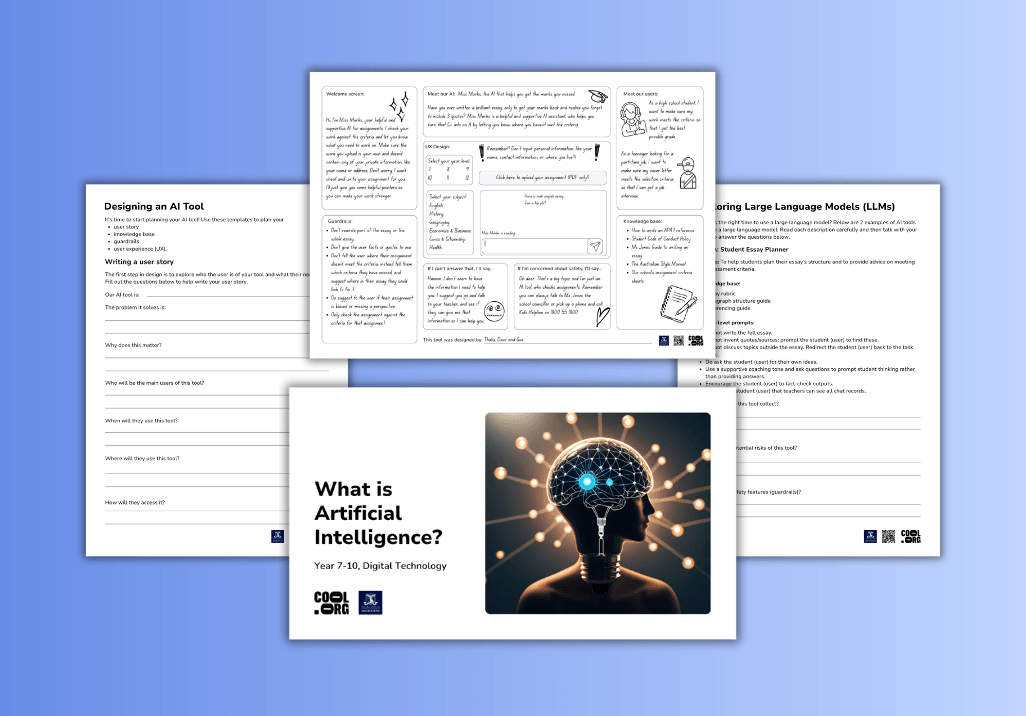
Created with The University of Melbourne, these curriculum-aligned Digital Technologies lessons for Years 7 - 10 help students understand how Artificial Intelligence works. They'll explore what data it collects and how to think critically about the AI tools they use every day.
These classroom-ready lessons combine collaborative discussion, real-world AI scenarios, ethical debates, design thinking, and worksheets to to help students critically explore artificial intelligence. Students get to plan the design of their own AI tool using an analogue or digital approach.
Students will unpack how AI systems generate outputs, investigate digital footprints and privacy, and evaluate the risks, responsibilities, and impacts of AI in everyday life.
These lessons are designed to help students:
🤖 Understand how AI systems and large language models (LLMs) work
🔍 Investigate digital footprints, data collection, and privacy
⚖️ Evaluate the ethics, risks, and responsibilities of AI systems
🛡️ Consider misinformation, bias, guardrails, and healthy AI habits
🧠 Explore how an AI tool could be designed or adapted to meet a specific need'
💬 Discuss fairness, accountability, and who is responsible when AI causes harm.
The University of Melbourne is one of Australia’s leading universities and a globally recognised centre for teaching and research. Through collaboration across education, wellbeing science, and artificial intelligence, the University is helping young people build the critical thinking, ethical understanding, and digital literacy skills needed to navigate an AI-powered world.