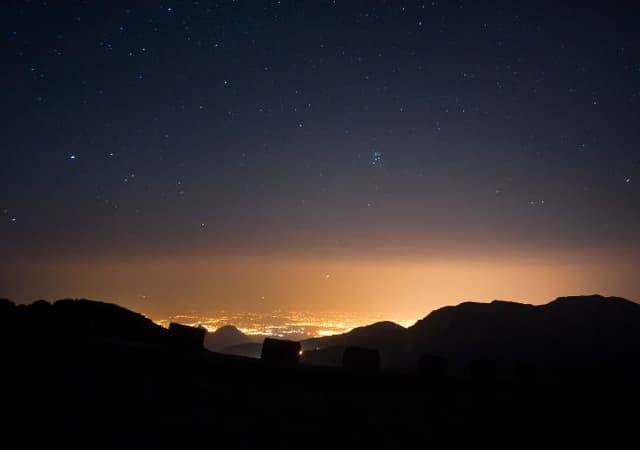
Understanding Light Pollution

Understanding Light Pollution

Lesson 1 of 3 in this unit

  • Foundation
  • Year 1 - 2
  • Humanities and Social Sciences
  • Geography
  • Environmental
  • Biodiversity
  • ...

Lesson summary

Students will discover the importance of periods of both light and darkness to living things by exploring how animals within their local area are impacted by artificial light within the environment.

Learning intentions:

Students will:

  • discover natural and man-made sources of light
  • explore how people influence the amount of light present in the environment, and how darkness can be valuable to people and animals
  • explore the impacts that artificial light has on people and animals at night.

Success criteria:

Students can:

  • identify natural and artificial sources of light
  • explain how people affect the amount of light in the environment
  • describe why darkness is important for people and animals, and how artificial light can be harmful at night.

Lesson guides and printables

View Lesson Guide
Lesson Plan
Flashcards Activity Sheet
Animal Factsheets

Curriculum links

Select your curriculum from the options below.

Lesson details

Skills

This lesson is designed to build students’ competencies in the following skills:

  • critical thinking
  • cultural understanding
  • curiosity
  • ethical understanding
  • intercultural understanding
  • problem solving

Curriculum Mapping

Australian Curriculum (v9.0) content description: 

Foundation

Students learn:

  • the features of familiar places they belong to, why some places are special and how places can be looked after (AC9HSFK03).

Year 1 

Students learn:

  • the natural, managed and constructed features of local places, and their location (AC9HS1K03).

Year 2

Students learn:

  • how places can be spatially represented in geographical divisions from local to regional to state/territory, and how people and places are interconnected across those scales (AC9HS2K03).

Relevant parts of Foundation achievement standards: Students recognise the features of familiar places, why some places are special to people and the ways they can care for them.

Relevant parts of Year 1 achievement standards: Students  identify the location and nature of the natural, managed and constructed features of local places, the ways places change, and how they can be cared for by people.

Relevant parts of Year 2 achievement standards: Students identify that places can be spatially represented in different geographical divisions.

NSW Syllabus outcomes: Stage 1

A student:

  • describes features of places and the connections people have with places (GE1-1)
  • identifies ways in which people interact with and care for places (GE1-2).

General capabilities: Critical and Creative Thinking, Intercultural Understanding, Literacy

Cross-curriculum priority: Aboriginal and Torres Strait Islander Histories and Cultures, Sustainability 

Level of teacher scaffolding: High - support age-appropriate research

UN Sustainable Development Goals

UN SDG 12: Ensure sustainable consumption and production patterns

  • Target 12.8: By 2030, ensure that people everywhere have the relevant information and awareness for sustainable development and lifestyles in harmony with nature.

Resources Required

  • Activity sheet - Flashcards
  • device capable of displaying audiovisual material
  • Factsheet - Animal factsheets
  • paper and pencils
  • whiteboard

Additional Info

This lesson was created in collaboration with The Biodiversity Council.

Special thanks to our content partner, The Conversation and to The Garry White Foundation, The Hugh D. T. Williamson Foundation, Wedgetail and The James Kirby Foundation for their generous financial support.

lesson saved in resources

Save

Share

More from this unit

See all
  • Lesson 2 of 3
  • Free
  • ...

Lights Out on Light Pollution

  • Primary
  • Foundation
  • Year 1 - 2
  • Humanities and Social Sciences
  • Geography
  • Environmental
  • Biodiversity
  • Lesson 3 of 3
  • Free
  • ...

Finding the Light

  • Primary
  • Foundation
  • Year 1 - 2
  • Humanities and Social Sciences
  • Geography
  • Environmental
  • Biodiversity
See all

Related content

Loading content...
Loading content...
Loading content...
Loading content...